
How Are Ocean Freight Rates Calculated? A Guide for Pakistani Exporters
Every exporter in Pakistan has seen freight quotes change without an obvious reason. The difference is rarely the container alone. Fuel prices, port charges, vessel capacity, currency fluctuations and seasonal demand all influence ocean freight rates.
Whether you ship through Karachi Port or use Port Qasim export shipping services, understanding these cost components helps you budget accurately and negotiate with confidence. This guide explains how ocean freight rates are calculated and what affects your final shipping quote.
- What Determines Ocean Freight Rates?
- Base Ocean Freight Rate: FCL vs LCL
- Container Type and Cargo Characteristics
- Fuel and Currency Surcharges: BAF and CAF
- Terminal Handling Charges and Port Related Fees
- Peak Season Surcharges and General Rate Increases
- Trade Lane, Route and Vessel Capacity
- Incoterms for Ocean Freight
- How Pakistani Exporters Can Get Better Ocean Freight Rates
- Conclusion
- Frequently Asked Questions
What Determines Ocean Freight Rates?
An ocean freight rate is never a single fixed price. It combines the base freight charge with various freight rate surcharges that reflect changing operating costs and market conditions.
A typical freight quotation may include:
- Base ocean freight
- BAF (Bunker Adjustment Factor)
- CAF (Currency Adjustment Factor)
- Terminal Handling Charges (THC)
- Peak Season Surcharge (PSS)
- General Rate Increase (GRI)
- Documentation and port related fees
Because these charges change over time, a quote received today may differ from one issued a few weeks earlier for the same destination. Market indexes such as the Freights Baltic Index regularly track these fluctuations across major trade lanes.
One common mistake exporters make is comparing a base freight quote from one provider with an all in freight quote from another. Since one excludes surcharges and the other includes them, the comparison is rarely accurate.
Base Ocean Freight Rate: FCL vs LCL
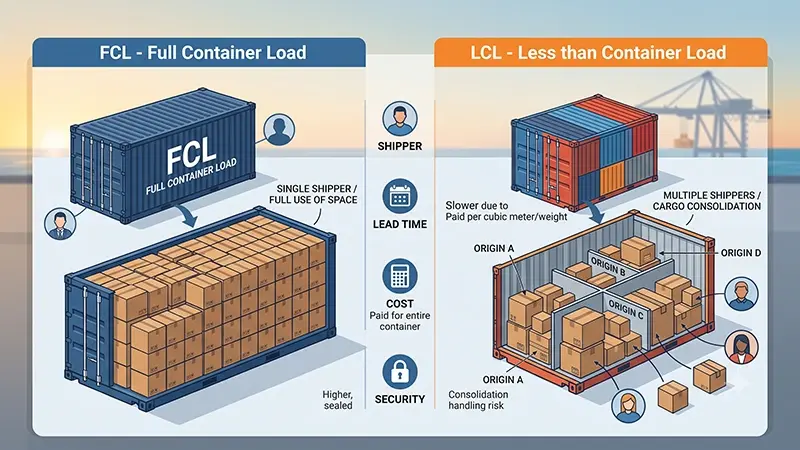
The base freight rate is the starting point for calculating shipping costs. It depends on whether cargo moves as a Full Container Load (FCL) or Less than Container Load (LCL).
- FCL: Charged per container, regardless of how much cargo it carries.
- LCL: Charged by cubic metre (CBM) or revenue ton, whichever is higher.
Understanding FCL vs LCL rates helps exporters choose the most cost effective option. As a general guideline, shipments above 12 to 15 CBM often become more economical as FCL, while smaller shipments usually benefit from ocean consolidation through scheduled LCL services.
Container Type and Cargo Characteristics
Container selection directly affects container shipping costs in Pakistan. Standard dry containers are the most economical, while specialized equipment costs more because of additional handling and operational requirements.
Common container types include:
- Standard dry containers
- Reefer containers
- Open top containers
- Flat rack containers
Cargo weight also influences pricing. Heavy shipments may exceed a carrier's weight limit for a single container, requiring additional equipment even when space is available. Hazardous or oversized cargo may also attract higher freight charges because of special handling requirements.
Fuel and Currency Surcharges: BAF and CAF
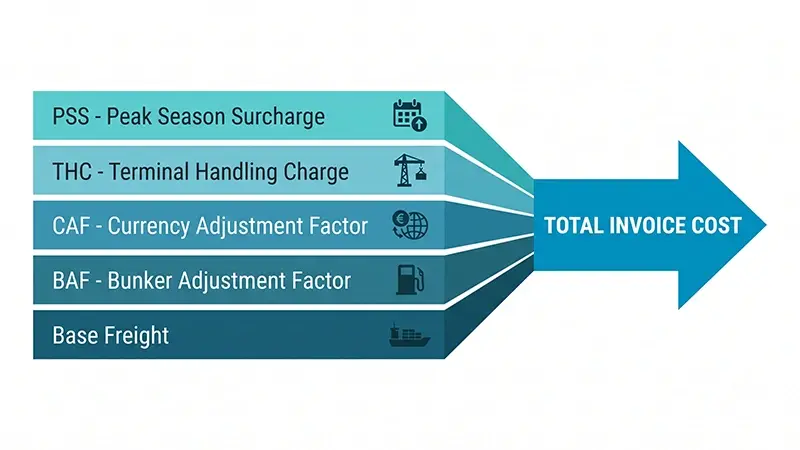
Fuel and exchange rates are two of the biggest reasons ocean freight rates change throughout the year.
The Bunker Adjustment Factor (BAF) covers fluctuations in bunker fuel prices, one of the largest operating costs for shipping lines. Depending on the carrier, BAF is reviewed monthly or quarterly and applied either as a fixed amount or a percentage of the base freight.
The Currency Adjustment Factor (CAF) protects carriers from exchange rate fluctuations when freight is quoted in one currency while operating costs are incurred in another.
To avoid unexpected costs, exporters should request an all in freight quote that combines the base freight with major surcharges, making it easier to compare quotations and budget accurately.
Terminal Handling Charges and Port Related Fees
Terminal Handling Charges (THC) cover the movement of containers through port terminals and are usually charged at both the origin and destination.
For shipments leaving Pakistan, freight quotations may include:
- Origin THC
- Destination THC
- Documentation fees
- Container seal charges
These charges are generally more stable than fuel related surcharges but can vary between terminals. If you are comparing Karachi Port shipping costs, always confirm whether THC and documentation fees are already included in the quotation.
Peak Season Surcharges and General Rate Increases
Not every freight increase is driven by fuel or currency. Some are based purely on market demand.
A Peak Season Surcharge (PSS) is introduced when demand for container space exceeds available capacity, particularly before major retail or holiday seasons.
A General Rate Increase (GRI) is a carrier announced adjustment that raises freight prices across selected trade lanes.
Booking shipments one or two weeks before expected peak periods can help reduce exposure to these additional costs.
Trade Lane, Route and Vessel Capacity
Shipping distance is only one factor behind freight pricing. Routes, transit schedules and trade lane vessel capacity also influence the final rate.
Direct sailings generally cost less and arrive faster than shipments requiring transshipment through regional hubs. Likewise, reduced sailings or limited container availability often lead to higher freight rates.
Carrier selection matters too. Different shipping lines may quote different prices for the same destination based on service frequency, transit time, available capacity and commercial pricing strategies. Comparing quotations from an experienced freight forwarder in Pakistan often delivers better value than simply choosing the lowest advertised rate.
Incoterms for Ocean Freight
Incoterms for ocean freight determine whether the buyer or seller is responsible for shipping costs.
The most common terms include:
- FOB (Free On Board): The buyer pays ocean freight once the cargo is loaded.
- CFR (Cost and Freight): The exporter pays ocean freight, while the buyer arranges insurance.
- CIF (Cost, Insurance and Freight): The exporter pays both freight and marine insurance to the destination port.
Exporters selling under CFR or CIF terms should secure an all in freight quote before finalising contracts, as changes in BAF, CAF or PSS can directly affect profitability.
How Pakistani Exporters Can Get Better Ocean Freight Rates
Managing ocean freight costs is not just about choosing the lowest quote. It is about knowing what is included and planning shipments properly.
Exporters can control costs by:
- Requesting an all in freight quote with base freight and major surcharges included
- Using ocean consolidation for smaller shipments under 12 to 15 CBM
- Booking before peak seasons to avoid PSS and GRI increases
- Comparing quotes on the same basis, not base rate against all inclusive pricing
- Negotiating volume rates for regular shipments
- Working with an experienced freight forwarder in Pakistan
Also remember that ocean freight rates do not include demurrage or detention. If containers stay beyond free time at the port, these charges can increase the total shipping cost.
Conclusion
Ocean freight rates are calculated through several layers, including base freight, BAF, CAF, Terminal Handling Charges, seasonal surcharges, vessel capacity and Incoterms for ocean freight. Pakistani exporters who understand these elements can budget better, compare quotes accurately and avoid unexpected shipping costs.
For businesses that need transparent pricing and dependable logistics support, Dynamic World Wide Logistics Group (DWWLG) provides ocean freight, ocean consolidation and end to end shipping solutions backed by strong partnerships with leading global carriers.
Frequently Asked Questions
1. How are ocean freight rates calculated?
By adding the base freight rate with surcharges such as BAF, CAF, THC and seasonal charges.
2. What is the difference between FCL and LCL rates?
FCL is charged per container, while LCL is charged by volume or weight.
3. Why do ocean freight rates change frequently?
They change due to fuel prices, currency shifts, vessel capacity and seasonal demand.
4. What are BAF and CAF in ocean freight?
BAF covers fuel changes, while CAF covers currency fluctuations.
5. Do Incoterms affect ocean freight costs?
Yes, they decide whether the buyer or seller pays ocean freight.
6. How can exporters get an accurate freight quote?
Ask for an all in freight quote from an experienced freight forwarder in Pakistan.