
What Happens to Pakistan's Shipping Costs When the Strait of Hormuz Is Disrupted?
Every time the Strait of Hormuz faces a crisis, Pakistan feels it almost immediately. Since February 28, 2026, the waterway has been largely blocked, and the ripple effects on freight rates, fuel costs, and trade flows have been severe. If you are a business owner, importer, or logistics professional in Pakistan, understanding what this disruption means for your bottom line is no longer optional. This is not a passing storm. It is a structural shift in how global cargo moves, and Pakistan sits right in its path.
- Why the Strait of Hormuz Is So Critical for Pakistan
- What Happens to Ocean Freight Rates
- The War Risk Insurance Problem
- How Fuel Costs Are Squeezing Domestic Logistics
- Pakistan's Exports Are Taking a Hit Too
- What Alternative Shipping Routes Are Available?
- What Pakistani Businesses Should Do Right Now
- How Long This Disruption Could Last?
- Conclusion
- Frequently Asked Questions
Why the Strait of Hormuz Is So Critical for Pakistan
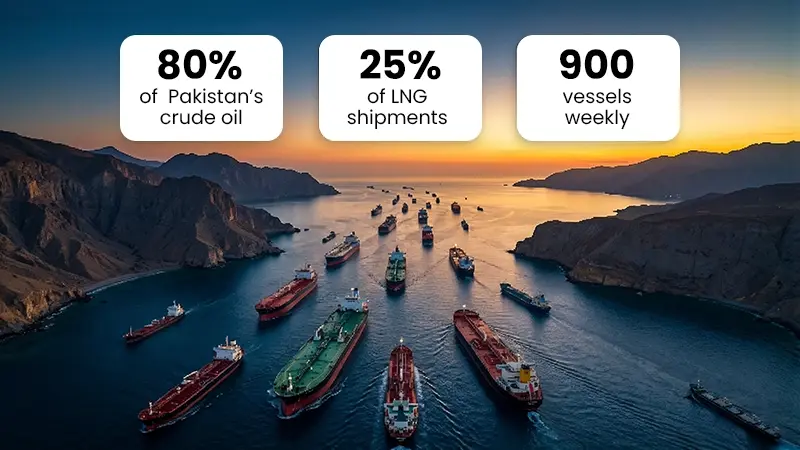
The Strait of Hormuz sits at the mouth of the Persian Gulf trade route, connecting Gulf energy producers to the Gulf of Oman. Roughly 20% of global seaborne oil trade and 900 vessels pass through it every week.
For Pakistan, the stakes are unusually high:
- Nearly 80% of crude oil imports transit this passage
- Around 25% of LNG shipments depend on this single route
- The 2019 Gulf tensions and 2024 Red Sea crisis already proved how exposed Pakistan's supply chain is here
A near-complete blockage triggers a chain reaction across ocean freight rates, war risk insurance, inland transport, and Pakistan imports export costs across every traded category.
What Happens to Ocean Freight Rates
When shipping lines suspend sailings through the strait, they reroute, and rerouting is expensive.
Most major carriers diverted vessels toward the Cape of Good Hope, bypassing both the Strait of Hormuz and the Suez Canal alternative route, which became untenable due to simultaneous Houthi threats in the Red Sea. This double disruption added two to three weeks to transit times and pushed bunker fuel costs significantly higher.
The result is that ocean freight rates Pakistan importers and exporters face have surged across every major trade lane:
- Emergency war risk surcharges of $1,500 to $3,500 per standard container unit
- Elevated base freight rates on Pakistan-Gulf and Pakistan-Europe lanes
- Karachi port trade disruption through transshipment rollovers and booking suspensions
The FPCCI confirmed that several shipping lines suspended Gulf-bound bookings from Pakistan entirely, hitting textile manufacturers, chemical importers, and industrial goods traders the hardest.
The War Risk Insurance Problem
This is where many businesses get caught off guard. Marine insurance is not a fixed cost. When a waterway is classified as a war risk zone, insurers either withdraw coverage or price it so high that the route becomes commercially unviable.
Here is what that looked like in practice:
- Marine insurers withdrew or sharply increased war risk coverage for ships in the Persian Gulf
- Pakistan's oil industry was forced onto a CIF basis, shifting insurance responsibility onto the seller
- War risk insurance cargo costs do not reset the moment a ceasefire is declared
Analysts warn that even after the strait reopens, insurance premiums could remain 20 times higher than pre-crisis levels for several months. The market takes time to trust a route again.
How Fuel Costs Are Squeezing Domestic Logistics
The disruption does not stay at sea. It travels inland.
When the oil tanker route disruption tightens global crude supply, oil prices Pakistan shipping operators pay spike almost immediately. Brent crude surged above $90 per barrel in the early weeks, feeding directly into a domestic diesel price increase of Rs55 per litre and pushing inland transportation costs up by an estimated 15 to 25%.
The practical consequences spread across the entire economy:
- Road freight costs between Karachi and upcountry destinations rose significantly
- Cold chain logistics for food and pharmaceuticals faced direct cost pressure
- Diesel-dependent manufacturing operations saw input costs climb
- Retailers and distributors passed the burden downstream to consumers
The ocean freight quote on your invoice is only one part of the problem.
Pakistan's Exports Are Taking a Hit Too
The assumption that this crisis only hurts importers misses half the picture.
Pakistan's textile sector generates over $16 billion in annual export earnings and depends heavily on Gulf sea lanes to reach European and American buyers. When freight rates spike and transit times stretch by weeks, exporters face a hard choice:
- Absorb the extra cost and protect the order
- Pass it on to buyers and risk losing business to Bangladesh, Vietnam, or India
Either way, they lose ground. Higher freight rates and war risk insurance premiums are reducing the price competitiveness of Pakistani manufacturing exports at exactly the wrong time. Supply chain disruption in Pakistan's export sector is not just a logistics problem. It is an economic one.
What Alternative Shipping Routes Are Available?
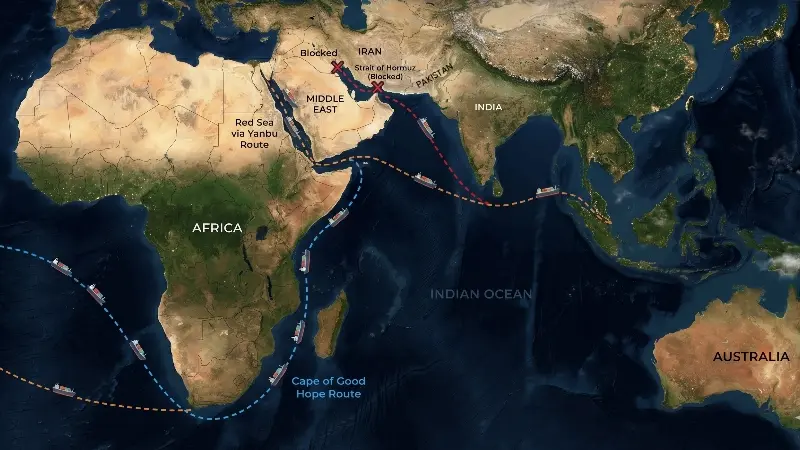
Pakistan is not without options. The alternative shipping routes Pakistan can access each come with real trade-offs, and none of them are cheap.
Yanbu and the Red Sea Route
Pakistan officially requested Saudi Arabia reroute crude oil shipments through the Red Sea port of Yanbu via the East-West Crude Oil Pipeline. Saudi Arabia arranged at least one such shipment. However, the combined pipeline capacity of Saudi Arabia and the UAE is around 9 million barrels per day, far short of the 20 million barrels that normally move through the strait. It partially fills the gap, not fully.
Cape of Good Hope
For containerized cargo, most shipping lines have shifted to this route. The cost is steep: two to three additional weeks of transit, higher fuel burn, and growing congestion as vessels crowd the alternate lane.
Oman's Arabian Sea Ports
Oman's ports of Duqm, Salalah, and Sohar on the Arabian Sea sit outside the strait entirely. They are being used increasingly as transshipment points for cargo needing to bypass the Persian Gulf trade route. For Pakistan, this adds complexity but removes the most dangerous segment of the journey.
None of the available Middle East shipping routes Pakistan can currently access offer a perfect substitute. They are workarounds, not solutions.
What Pakistani Businesses Should Do Right Now
If you are managing a supply chain in Pakistan, a few things deserve immediate attention:
- Review freight contracts for flexibility on surcharges, as fixed 30-day rate agreements are breaking down
- Increase safety stock levels to absorb the impact of longer transit times
- Verify that your cargo insurance explicitly covers war risk zones. Our custom house brokerage team can help you navigate documentation and compliance requirements
- Identify non-Gulf sourcing alternatives for key raw materials
- Watch LNG supply developments closely, as QatarEnergy declared force majeure early in the crisis and power generation costs remain at risk
How Long This Disruption Could Last?
Pentagon officials stated in April 2026 that fully clearing mines from the strait could take up to six months after the conflict ends. Even after that, insurers are unlikely to immediately reclassify the corridor as safe, meaning elevated freight costs and restricted sailings could persist well into 2027.
UNCTAD projects global merchandise trade growth will slow from 4.7% in 2025 to between 1.5% and 2.5% in 2026. For Pakistan, which is already managing tight foreign exchange reserves, a prolonged period of elevated geopolitical impact on freight rates is a pressure it can ill afford.
The Strait of Hormuz shipping disruption is not a two-week event. Businesses planning only for the short term are likely underestimating the timeline significantly.
Conclusion
A disruption in the Strait of Hormuz is not just a short-term shock. For Pakistan, a country where nearly 80% of crude oil imports move through a single chokepoint, it drives lasting increases in fuel costs, freight rates, and pressure across the entire supply chain.
Businesses that treat it as temporary risk falling behind. Adapting early through diversified sourcing, flexible logistics, and planning for longer transit times is essential in today's volatile trade environment.
As global shipping patterns shift, the right logistics partner becomes critical. Dynamic Worldwide Logistics Group (DWWLG) helps businesses navigate disruptions, control costs, and keep supply chains moving with confidence.
Frequently Asked Questions
1. How much have freight surcharges increased for Pakistani importers due to the Strait of Hormuz disruption?
Shipping lines are imposing emergency war risk surcharges of $1,500 to $3,500 per container unit on top of already elevated base freight rates.
2. Which Pakistani export sector is most affected by this disruption?
The textile sector is most exposed, as it depends heavily on Gulf sea lanes to reach European and American buyers competitively.
3. Can Pakistan fully replace Strait of Hormuz oil imports through alternative routes?
No, because alternative pipeline capacity of around 9 million barrels per day falls well short of the 20 million barrels the strait normally handles.
4. Why is war risk insurance such a big problem even after a ceasefire?
Insurers take months to reclassify a war zone as safe, meaning premiums can remain 20 times higher than pre-crisis levels long after hostilities end.
5. How does the Hormuz disruption affect Pakistan's domestic fuel and transport costs?
It pushed diesel prices up by Rs55 per litre, raising inland transportation costs by an estimated 15 to 25% across road freight and manufacturing operations.